Storefronts Coloring Pages: Where Urban Charm Meets Mindful Creativity
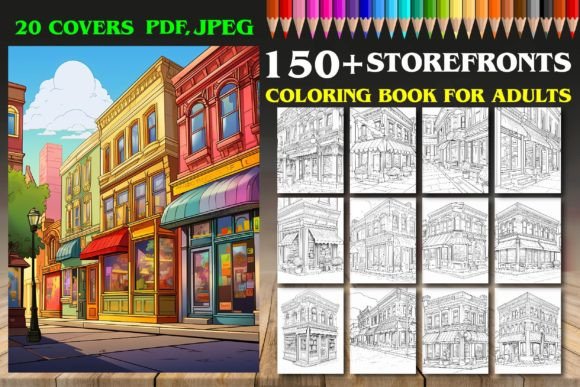
There’s something quietly powerful about a well-designed storefront—the careful balance of signage, window display, architectural detail, and personality. For decades, these small-scale facades have anchored neighborhoods, reflected local identity, and invited curiosity. Today, that same sense of grounded presence has found new life—not in brick and mortar, but in the deliberate, meditative act of coloring. Storefronts Coloring Pages transforms that everyday visual language into a therapeutic tool: 150+ intricately drawn, black-and-white scenes of cafés, boutiques, bookshops, bakeries, florists, and vintage shops—each designed to engage focus without demanding expertise.
Why Storefronts? A Shift Toward Meaningful Detail
Adult coloring has evolved far beyond simple florals and mandalas. Today’s users seek themes with narrative weight—scenes that spark recognition, memory, or gentle daydreaming. Storefronts fit this need precisely. They’re familiar yet richly varied: a corner deli with striped awning and hand-painted lettering; a Parisian patisserie with wrought-iron balcony and stacked macaron boxes; a coastal gift shop with nautical signage and weathered shingles. These aren’t generic templates—they’re carefully observed compositions that reward close attention.
This reflects broader shifts in how adults approach creative time. We’re less interested in “finishing” an activity and more invested in the quality of the experience itself—slowing down, noticing texture, making micro-decisions (Will the awning be ochre or slate blue? Do the windowpanes stay clear or get stained-glass treatment?). Storefronts Coloring Pages supports that intentionality with consistent line weight, balanced negative space, and layered elements—awnings, signage, potted plants, window displays—that invite pacing, not rushing.
Designed for Real Life—Not Just Idealized Leisure
Let’s be realistic: most adults don’t have uninterrupted two-hour blocks for coloring. What they *do* have is fragmented time—15 minutes before a meeting, 20 minutes after dinner, a quiet Saturday morning before the rest of the household stirs. That’s why every page in this collection is sized at A4 / 8.5×11 inches and delivered as both individual JPEG files and a single, print-ready PDF. No wrestling with formatting. No waiting for software to load. Just open, print, and begin.
The 300 DPI resolution isn’t just a technical spec—it’s functional assurance. Crisp lines hold up whether you’re using fine-tip gel pens, soft pencils, or watercolor brushes. And because each image is delivered separately, you can easily rotate, crop, or print only the pages that resonate *today*. Feeling nostalgic? Pull up the soda fountain scene. Craving calm? Choose the quiet bookstore with rain-streaked windows. There’s no pressure to follow sequence—just permission to meet yourself where you are.
More Than Relaxation: A Subtle Practice in Observation and Choice
Coloring storefronts does more than lower heart rate—it gently trains observational skills. To fill in the subtle gradation of brickwork, the rhythm of shutter slats, or the delicate script on a chalkboard sign requires sustained, low-stakes attention. That’s not distraction; it’s cognitive anchoring. Research in art therapy consistently links repetitive, detail-oriented tasks with reduced activity in the amygdala—the brain’s threat-response center—and increased coherence in the prefrontal cortex, where planning and self-regulation live.
But unlike guided meditation apps or timed breathing exercises, Storefronts Coloring Pages offers agency. You decide the palette. You choose where to start. You pause mid-awning and switch to the planter box instead. That autonomy matters—especially for professionals, educators, and caregivers whose days are often shaped by external demands. Here, the only agenda is your own rhythm.
Practical Value for Creators and Small Businesses
For designers, marketers, and KDP publishers, this collection serves a dual purpose. First, as a working resource: the 20 high-res PNG cover files (also at 300 DPI) are fully editable—ideal for customizing thumbnails, social media banners, or printable promo cards. Second, as inspiration. Studying how architectural elements translate into clean linework—how depth is suggested through shadow placement rather than shading—sharpens visual communication instincts. Many freelance illustrators use coloring pages like these as warm-up exercises to loosen rigid habits and reconnect with expressive mark-making.
Small business owners—especially those running boutiques, studios, or local services—also find unexpected utility. Printing select pages as in-store activity sheets (for kids or waiting guests), embedding them in email newsletters as “pause-and-color” moments, or even adapting motifs for seasonal social posts adds warmth and authenticity without requiring original illustration work.
Thoughtful Design, Not Just More Pages
It’s easy to assume “150 pages” means volume over vision. But what makes Storefronts Coloring Pages distinctive is curation—not quantity alone. Each design avoids visual clutter while preserving character: no overcrowded windows, no competing patterns that fatigue the eye. Door handles have weight. Signage has legibility—even in silhouette. Awning folds follow logical light direction. These details matter because they reduce decision fatigue (“What even *is* that shape?”) and increase flow state potential.
You’ll notice thoughtful repetitions too: several café scenes vary in angle and season (one with autumn leaves, another with summer string lights), allowing exploration without repetition. The collection includes global references—Tokyo alleyway shops, Mediterranean tilework, Midwestern main street diners—but avoids caricature. Respect for real places translates into respect for the colorist’s time and attention.
Integrating Into Modern Routines—Without Adding Friction
Unlike physical books that gather dust on shelves or subscriptions that expire mid-session, this digital collection lives where your workflow already does. Save the PDF to your tablet for coloring during commutes (with a stylus and app like GoodNotes). Drag JPEGs into Canva to build custom mood boards. Print one page weekly and pin it beside your desk—not as decoration, but as a tactile reminder to reset. The flexibility removes barriers: no shipping delays, no storage concerns, no guilt about “not finishing.”
And because the files are universally compatible (no proprietary software required), they integrate seamlessly whether you’re a seasoned digital artist or someone who last held colored pencils in seventh grade. The barrier to entry is low. The depth of engagement is yours to define.
A Quiet Counterpoint to Constant Input
In a world saturated with algorithmically optimized feeds, auto-playing videos, and relentless notifications, choosing to color a single storefront—observing how light falls across its facade, deciding which flowers go in the window box, letting your hand move slowly along a hand-drawn cornice—is quietly radical. It’s not about escaping reality. It’s about re-engaging with it more deliberately.
Storefronts Coloring Pages doesn’t promise transformation. It offers texture. It offers pause. It offers 150 distinct invitations—to look closely, choose freely, and return, just for a few minutes, to the satisfaction of line and color meeting intention. Whether you’re unwinding after back-to-back Zoom calls, sketching ideas between client revisions, or simply reclaiming a sliver of quiet in a noisy day, these pages meet you with consistency, care, and quiet charm.