Kawaii Ballerina Coloring Pages for Kids
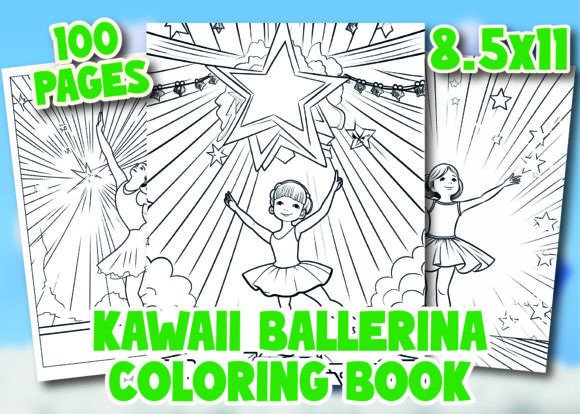
Imagine opening a coloring book where every page invites gentle focus—not just for children, but for anyone who values soft creativity, intentional design, and joyful repetition. Kawaii Ballerina Coloring Pages for Kids isn’t just another themed collection. It’s a thoughtfully built creative toolkit: 100 unique, hand-crafted line art illustrations—each one balanced between simplicity and charm, accessibility and personality.
These aren’t generic ballerinas in stiff poses. They’re kawaii-inspired: round faces, expressive eyes, fluttering ribbons, oversized bows, twirling skirts, and tiny ballet slippers with heart-shaped soles. The style merges Japanese cuteness with classic dance grace—making it instantly recognizable, emotionally warm, and highly adaptable across age groups and use cases.
Why This Set Stands Out for Creators and Educators
Most coloring books prioritize quantity over consistency. This set does both—without compromise. Every illustration is drawn at true 8.5″ × 11″ scale, optimized for clarity at print resolution (300 DPI), and designed with generous white space around each figure. That means no awkward cropping when printed or resized. No thin lines that vanish on home printers. No overlapping elements that confuse young colorists.
The 100 pages include diverse poses—leaping, curtsying, stretching, balancing on one toe, holding flowers or music boxes—and subtle variations in costume, hair, accessories, and background elements (like stars, clouds, or cherry blossoms). But they all share the same clean, confident linework—so your final interior feels cohesive, not chaotic.
Real-World Uses Beyond “Just Coloring”
This isn’t only for kids’ quiet time. Designers use these pages as foundational assets for larger projects:
- Custom merchandise: Isolate a single PNG (from the included 100 high-res files) and add it to mugs, tote bags, or enamel pins—no redrawing needed.
- Educational tools: Teachers print individual pages to reinforce fine motor skills, color theory lessons, or cultural themes (e.g., pairing kawaii aesthetics with Japanese festivals or dance history).
- Digital product expansion: Import the AI source file into Illustrator or Affinity Designer to recolor, layer, animate, or combine with typography for social media templates or printable planners.
- Brand-aligned content: A yoga studio or children’s boutique can license select pages for email headers, blog graphics, or in-store activity sheets—keeping visual tone consistent without commissioning custom art.
Freelancers and small publishers especially benefit from the dual-format delivery: the ready-to-print PDF ensures fast KDP uploads, while the editable AI file gives full control over stroke weight, spacing, or layout adjustments—say, adding a border, resizing for a 6″ × 9″ edition, or converting a page into a tracing sheet.
Design Integrity Meets Practical Flexibility
We built this set knowing creators need reliability—not just inspiration. That’s why every page was tested across multiple printers (inkjet and laser), reviewed for line contrast, and adjusted to avoid unintentional “bleed-through” on standard 24–28 lb paper. No shading, no grayscale tones—just crisp black-and-white outlines, purpose-built for coloring, scanning, or digital reuse.
The cover images included are fully customizable: two vertical options (front + back), sized to KDP’s exact spine-width calculations based on your chosen page count. You’re not stuck with placeholder text—you get layered, editable covers you can brand in minutes.
How to Keep Your Adaptations Audience-Friendly
If you’re assembling your own KDP interior, here’s what makes it work long-term:
- Group by complexity: Start with simpler figures (standing poses, minimal details) in the first third of the book—then gradually introduce more dynamic stances and decorative elements. This supports developmental progression for kids *and* builds confidence for adult colorists.
- Maintain breathing room: Never crowd pages. Leave margins wide enough for binding (at least 0.5″ inner margin for KDP’s perfect binding). Our files already respect that—so if you’re reordering pages, keep that spacing intact.
- Add subtle utility: Consider inserting 2–3 blank practice pages mid-book (not included, but easy to add using the AI file). Or insert a “Color Palette Guide” page at the end—using the same kawaii palette (soft pinks, mint, lavender, butter yellow) to suggest harmonious combinations.
- Test readability at scale: Zoom out to 25% view in your PDF editor. If lines blur, overlap, or disappear, adjust stroke weight before final export. Our files pass this test—but if you modify them, verify it still holds.
Ideas for Cross-Platform Extension
Your audience doesn’t live in one place. Extend value beyond the printed book:
- Create a free companion printable download—a single-page “Ballerina Pose Chart” or “Color Matching Cheat Sheet”—to grow your email list.
- Turn 5 favorite pages into Instagram carousels: “Color One Pose, 3 Ways” showing watercolor, marker, and colored pencil techniques.
- License select illustrations to educational app developers for interactive coloring modules—especially useful for speech therapists using visual cues during sessions.
- Bundle with a short audio guide (“Calm Ballet Breathing for Kids”) for a premium digital package—ideal for homeschool co-ops or occupational therapy practices.
What matters most isn’t how many pages you have—it’s how intentionally each one serves its purpose. These Kawaii Ballerina Coloring Pages for Kids were drawn with that principle in mind: no filler, no visual noise, no guesswork. Just 100 distinct, usable, joyful starting points—ready for your voice, your audience, and your next idea.
Whether you're launching your first KDP coloring book, building a teaching resource library, or designing a client’s branded activity kit—this set gives you structure *and* freedom. You bring the vision. We’ve handled the foundation.