Ocean Animals Coloring Pages for Adult
Coloring isn’t just for kids anymore—it’s a proven tool for focus, stress relief, and creative expression among adults. Ocean Animals Coloring Pages for Adult taps into that demand with a thoughtfully curated, production-ready collection designed specifically for creators who value both aesthetic depth and technical precision. This isn’t a generic set of clipart-style fish and coral. It’s 100 original, AI-assisted illustrations—refined to deliver the nuance, line clarity, and compositional balance that adult colorists genuinely appreciate.
Why These Pages Stand Out for Creative Professionals
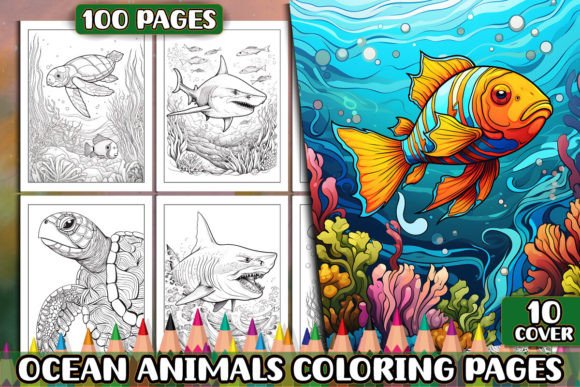
What makes this set different from dozens of others on the market? It starts with intentionality in design and execution. Each illustration was generated and manually reviewed to ensure clean linework at 300 DPI, consistent stroke weight, and thoughtful negative space—critical for both coloring enjoyment and print fidelity. The ocean theme isn’t treated superficially: you’ll find anglerfish with delicate bioluminescent details, sea turtles with textured shell patterns, octopuses wrapped around geometric coral formations, and deep-sea jellyfish rendered with flowing, rhythmic lines that invite shading and layering.
The file structure reflects real-world workflow needs. Instead of one bloated PDF or low-res JPEGs, you receive four organized folders: 100 print-ready PDFs (A4 / 8.5” × 11”), 100 high-resolution JPGs (ideal for digital previews or social media teasers), 100 transparent-background PNGs (perfect for overlays, merch mockups, or Canva-based product bundles), and 10 professional cover images—each sized and styled for Amazon KDP’s thumbnail and interior requirements.
Practical Uses Across Multiple Creative Paths
This collection is built for flexibility—not just “coloring book” use. Here’s how different professionals can apply it:
- Amazon KDP Publishers: Launch a standalone ocean-themed coloring book in under an hour. Use the included covers, format the PDFs using Kindle Direct Publishing’s template guide, and upload. No design software needed—you’re already working with print-optimized files. Add value by bundling with a short “Ocean Mindfulness Tips” intro page (written in your voice) to differentiate your listing.
- Print-on-Demand Sellers: Isolate individual illustrations (using the PNGs) and place them on mugs, tote bags, journals, or phone cases. The clean black-and-white line art scales well and converts reliably to vector-friendly raster assets. Test variations: a single giant nautilus on a navy canvas tote, or a subtle pattern of plankton and seahorses along the spine of a notebook.
- Educators & Therapists: Use select pages in marine biology units or sensory regulation activities. The realistic anatomy—like gill slits on a manta ray or barnacle textures on whale skin—supports learning without sacrificing artistic appeal. Pair pages with short, factual captions (e.g., “This viperfish uses its elongated teeth to trap prey in total darkness”) for classroom handouts.
- Content Creators & Bloggers: Feature individual pages as free downloadable lead magnets (“Get your free deep-sea anglerfish coloring page + 3 ocean calm breathing prompts”). Repurpose the JPGs into Instagram carousels showing step-by-step colored versions, time-lapse reels, or side-by-side comparisons of watercolor vs. colored pencil techniques.
Design Integrity Meets Real-World Production Needs
Yes, these are AI-generated—but not in the way most people assume. The output was guided by constraints that prioritize human usability: no overlapping lines, no ambiguous silhouettes, no unintended gaps in closed shapes. That means fewer corrections when prepping files for print, less risk of blurry edges on KDP’s previewer, and smoother integration into third-party tools like Adobe Express or Gelato’s POD dashboard.
You also get full commercial rights. That means you can legally sell physical books, digital downloads, NFT derivatives (with proper platform compliance), or even license select designs to educational platforms—all without clearing additional permissions. Just keep your branding consistent, credit your source appropriately if required by your platform, and maintain the integrity of the artwork (no stretching, warping, or auto-coloring that degrades line quality).
Getting Started—Fast, Focused, and Effective
You’ll receive everything in a single ZIP file—no fragmented links or confusing cloud folders. Extract it, and you’ll immediately see the logic: PDFs in one folder, JPGs in another, etc. If you’re new to KDP, start here:
- Open one PDF in Acrobat or Preview. Check margins—these are already set to KDP’s 0.25” bleed-safe zone.
- Pick three covers. Upload each to KDP’s cover calculator. Adjust text placement only where needed—the typography space is intentionally generous.
- Combine 50–75 pages into a single interior PDF (KDP accepts up to 800 pages; 100 gives you room for title, intro, and back matter).
- Run a soft proof. Because all files are 300 DPI and CMYK-safe, what you see on screen closely matches the printed result.
For designers building custom products: use the PNGs in Figma or Illustrator. Drop them onto templates, adjust opacity for watermark effects, or trace over them to create layered SVG assets. The resolution holds up even when enlarged to poster size (24” × 36”)—just resample carefully in Photoshop using “Preserve Details 2.0” to avoid pixelation.
Who Benefits Most—and Why
This collection serves creators who understand that quality infrastructure saves time, builds trust, and compounds returns. A freelance graphic designer launching a boutique stationery line doesn’t need to redraw every seahorse—they need reliable, licensable assets that match their brand’s tone. An educator running after-school STEM clubs needs pages that spark curiosity *and* hold up under repeated photocopying. A solopreneur testing KDP niches needs fast-to-market, low-risk inventory—no inventory at all, in fact.
It’s not about replacing skill. It’s about removing friction. When your tools are precise, well-organized, and audience-tested, you spend less time troubleshooting files and more time connecting with people through color, story, and shared wonder—for the ocean, for creativity, and for the quiet focus that comes when pen meets paper.