Blank Monthly Calendar Canva KDP
A Blank Monthly Calendar Canva KDP isn’t just another printable—it’s a strategic planning asset designed for clarity, consistency, and control. Whether you're launching your first KDP planner series, building a branded resource library for clients, or streamlining your own monthly review system, this editable interior gives you full creative authority without compromising print readiness or professional polish.
Why Editable Control Matters More Than You Think
Most calendar templates lock you into someone else’s design logic: fixed fonts, rigid spacing, preset color palettes, or non-scalable layouts. That limits how well the tool serves your actual goals. With a Blank Monthly Calendar Canva KDP, every element—font family, hierarchy, margin balance, grid density, header weight—is adjustable. You decide whether January needs bold headers for team deadlines, subtle pastel accents for wellness tracking, or photo placeholders for client project milestones.
This level of customization supports intentionality—not decoration. When your calendar reflects your workflow (not a generic aesthetic), it becomes easier to spot patterns, align priorities, and reduce cognitive load during planning sessions. For educators, that means embedding curriculum pacing cues directly into each month. For freelancers, it means reserving space for invoice due dates alongside creative blocks. For small business owners, it means mapping marketing campaigns against inventory cycles—visually, consistently, and without manual redrawing.
Strategic Use Cases Beyond “Just Printing”
Think beyond passive consumption. A Blank Monthly Calendar Canva KDP gains value when embedded in systems—not isolated as a standalone file.
- Product Development: Launch a niche planner line (e.g., “Freelancer Finance Tracker” or “Teacher Lesson Planner”) using the same base structure but with purpose-built sections—budget columns, grade-level tags, or client contact fields—all added directly in Canva before exporting.
- Client Onboarding: Customize one version per service offering—add your logo, brand colors, and a branded “Notes” section where clients record goals or feedback. The clean 11 x 8.5 inch size fits standard binders and desk setups, reinforcing professionalism at first glance.
- Internal Operations: Use the editable link to create department-specific versions—HR adds PTO tracking rows; marketing inserts campaign launch windows; operations embed equipment maintenance reminders. No need to maintain multiple files—just duplicate and refine within Canva.
- Learning & Reflection: Students, coaches, and lifelong learners benefit from blank space that invites annotation—not pre-filled prompts that assume how time should be interpreted. Let users define what “important” means for them each month.
What to Consider Before You Customize
Editing freedom is powerful—but only when guided by purpose. Ask yourself before opening the Canva link:
- Who is the primary user? A student needs different visual cues than a real estate agent managing open houses. Clarity trumps creativity when usability is on the line.
- What decisions must this calendar support? If weekly review is central, ensure enough white space for reflection—not just date boxes. If deadline visibility is critical, emphasize typography hierarchy over decorative borders.
- How will it integrate with existing tools? Will it sit beside a digital task manager? Be scanned into a note-taking app? Designed for handwritten input? These constraints shape layout choices—like line height, margin width, and font legibility at 100% zoom.
- What’s the long-term maintenance plan? Since you get lifetime access to the editable link, consider versioning: save dated copies (“Q3-2024-Client-Planner”) so updates don’t overwrite prior iterations used in live projects.
Print-Ready Integrity Without Compromise
The included high-quality PDFs aren’t afterthoughts—they’re production-grade outputs. At 11 x 8.5 inches with no bleed, they align precisely with standard US letter-sized printing, whether you’re using a home inkjet, local print shop, or KDP’s print-on-demand service. JPG and PNG exports add flexibility: paste pages into presentations, layer over social media graphics, or embed in email newsletters as visual anchors.
But resolution alone doesn’t guarantee effectiveness. What makes these files truly ready is their structural neutrality—no watermarks, no forced branding, no locked layers. You control the message, tone, and function. That neutrality is rare in editable KDP interiors—and essential if you plan to scale across audiences or repurpose content.
Risks of Editing Without Strategy
It’s easy to fall into the “more is better” trap: adding icons, gradients, extra calendars per page, or decorative dividers—only to discover later that the layout feels cluttered, slows down writing, or fails accessibility checks (e.g., low contrast text). Worse, inconsistent styling across months can undermine trust in your product’s polish.
Another common misstep: over-personalizing for one use case and losing versatility. A version built exclusively for meal planning may alienate productivity-focused buyers—even if the underlying template is technically the same. Keep core functionality intact (clear date alignment, logical spacing, intuitive navigation) while layering on specialized features only where they serve measurable outcomes.
Design Decisions That Support Long-Term Use
The clean and minimal design isn’t stylistic preference—it’s functional discipline. Minimalism here means removing anything that competes with the user’s attention or interrupts flow. That includes:
- Consistent vertical rhythm between months—so flipping from June to July feels seamless, not jarring.
- Ample margin space—not just for binding, but for margin notes, sticky tabs, or future annotations without crowding the main grid.
- Typefaces chosen for legibility at small sizes (especially important for handwritten entries) and scalability across devices during editing.
- Thoughtful placement of the “Notes” and “Thank You” pages—not as filler, but as intentional pauses for reflection and gratitude practice, both proven contributors to sustained motivation and decision quality.
Getting Started Intentionally
Don’t start by changing colors. Start by defining the outcome you want the calendar to enable. Is it faster weekly planning? Stronger client communication? Better habit formation? Once that’s clear, let each edit serve that goal. Change font size to improve readability—not because it looks “modern.” Adjust column width to accommodate recurring tasks—not to mimic another designer’s layout. Add photos only when they reinforce meaning (e.g., a team photo on a collaborative project calendar), not as decoration.
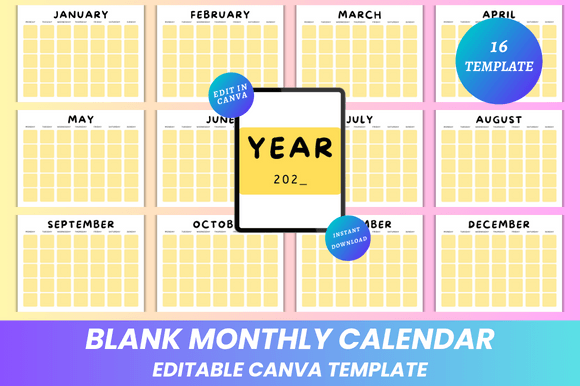
You’ll receive 16 pages total—including all twelve months plus “Belongs To,” “Notes,” and “Thank You”—all sized to work immediately in Canva, KDP, or any print environment. And because you get instant download and lifetime access, there’s no pressure to finalize everything at once. Test a single month with your team. Share a draft with beta users. Iterate based on real feedback—not assumptions.
Final Thought: Tools Shape Behavior
A Blank Monthly Calendar Canva KDP does more than hold dates. It shapes how you see time, prioritize action, and communicate expectations. When edited with clarity and care, it becomes less of a template and more of a thinking partner—one that grows with your goals, adapts to your rhythms, and stays useful across seasons, roles, and ambitions. New designs are added regularly—not to chase trends, but to deepen utility. Come back when your needs evolve. Your next iteration is already in motion.