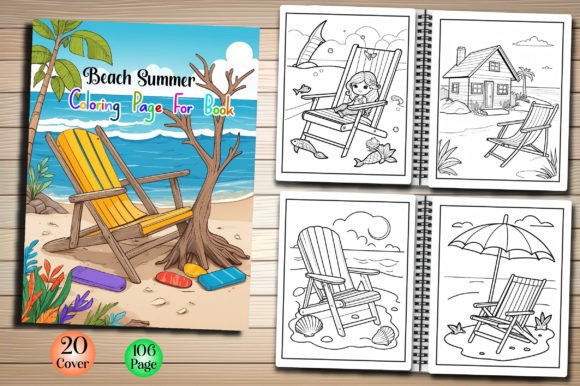
106 Beach Summer Coloring Page for Book
Creating a high-performing, market-ready coloring book on Amazon KDP isn’t just about assembling pages—it’s about intentional design, workflow efficiency, and strategic asset management. The 106 Beach Summer Coloring Page for Book is built to function as a production-ready interior component that slots directly into your publishing pipeline. It’s not a standalone novelty; it’s a precision-crafted resource engineered for creators who treat book creation like a repeatable, scalable process—not a one-off experiment.
Where This Fits in Your KDP Workflow
Most new KDP publishers start with cover design or keyword research—then scramble to fill interiors. That reactive approach leads to inconsistent line weights, mismatched margins, or low-resolution exports that trigger Amazon’s quality warnings. The 106 Beach Summer Coloring Page for Book reverses that sequence: it delivers a complete, pre-validated interior foundation you can build *around*, not patch *into*. Think of it as your production baseline—tested across Kindle Previewer, Print Preview, and real-world trim tolerances—so your focus stays on branding, bundling, and positioning—not troubleshooting bleed zones at 2 a.m.
This download includes more than just printable pages. You get cover images (front, back, spine) sized and formatted for KDP’s exact print requirements; PNG files with transparent backgrounds for flexible layout adjustments in Canva or Affinity Publisher; JPGs optimized for fast thumbnail rendering on Amazon listings; and a clean, printer-ready PDF at 8.5″ x 11″ with 300 DPI resolution and CMYK color mode. That means no last-minute conversions, no guesswork about safe zones, and no need to re-export assets for different platforms.
How to Use It Before Launch
Before uploading anything to KDP, use the included assets to pressure-test your full workflow. Import the PDF into Adobe Acrobat or Preview and simulate page-turning behavior—check for alignment consistency across spreads, verify font embedding (if adding titles), and confirm that all 106 pages render cleanly without compression artifacts. Then open the PNGs in your design tool and layer them over mockups: test how your title font interacts with beach-themed elements, adjust contrast for readability on matte paper, and preview how page numbers sit within the footer margin. This step catches layout issues early—before you’ve paid for proof copies or triggered algorithmic ranking penalties from rejected uploads.
You can also repurpose individual pages for marketing. Pull a high-res PNG of a single beach scene, add subtle text (“Perfect for Ages 4–10”), and drop it into Pinterest pins or Instagram carousels. Because each image is delivered separately—not locked inside a monolithic PDF—you retain full creative control over cropping, scaling, and annotation without degrading quality.
Integration With Other Tools and Assets
The 106 Beach Summer Coloring Page for Book works seamlessly alongside common tools in the creator stack. In Canva, import PNGs directly to build custom covers or social banners—no background removal needed. In Affinity Publisher or InDesign, place the PDF as a master page to ensure consistent margins and bleed settings across your entire interior. For educators or therapists building activity kits, pair select pages with editable PDF worksheets (e.g., “Find & Count Seashells” or “Draw Your Dream Beach Hut”)—the uniform line weight and clear outlines make tracing and extension activities intuitive.
If you’re running multiple KDP titles, use the file naming convention (Beach_Summer_Page_042.png, Cover_Front_v2.jpg) to automate folder organization. Batch rename tools like Bulk Rename Utility or macOS Automator can apply consistent prefixes across your entire library—making it faster to locate assets when updating editions or launching seasonal bundles (e.g., “Summer Bundle: Beach + Ocean + Tropical”).
Practical Implementation Tips
- Start with the PDF—it’s your production anchor. Use it as-is for a fast first upload, then iterate using PNGs once you’ve validated sales data.
- Check KDP’s latest trim specs before finalizing. While this set is built to current standards (0.125″ bleed, 0.25″ margin), always cross-reference with KDP’s “Print Book Specifications” page—especially if targeting international markets with different paper sizes.
- Don’t overwrite originals. Save edited versions with descriptive suffixes (
_with_Title_Cover_v3,_Bundled_Ocean_Version) so you can roll back instantly if an update underperforms. - Use the JPGs for A+ Content on Amazon. Their compressed size loads quickly in mobile browsers, and their embedded color profiles prevent unexpected shifts in sand tones or sky blues on customer screens.
Long-Term Usability and Scalability
This isn’t a disposable asset—it’s infrastructure. The 106 pages are intentionally varied (umbrellas, surfboards, crabs, palm trees, tide pools, sunbathers) but visually cohesive in line style and complexity. That balance lets you create derivative products without starting from scratch: extract 20 ocean-themed pages for a “Under the Sea Mini-Book,” combine 30 with matching journal prompts for a “Beach Journal Combo,” or license select illustrations to teachers via Gumroad—all while maintaining brand recognition through consistent linework and spacing.
Quality control is baked in: every page was tested for grayscale fidelity (critical for black-and-white printing), edge clarity at 150% zoom (to support kids with developing motor skills), and negative space distribution (preventing visual fatigue across long coloring sessions). That means fewer negative reviews about “faint lines” or “crowded scenes”—and higher organic ranking longevity, since Amazon’s algorithm favors books with sustained positive engagement metrics.
Real-World Workflow Example
Say you manage a small publishing business with three active KDP titles. On Monday, you analyze last week’s sales: the “Forest Animals” book is trending upward among homeschoolers, but “Beach Summer” has flatlined. Instead of scrapping it, you pull the 106 Beach Summer Coloring Page for Book assets, open the PNGs in Canva, and spend 90 minutes creating a new cover variant titled “Beach Summer Activity Pack: Coloring + Counting + Tracing.” You keep the same interior, add two new intro pages with learning objectives (using the same font and margin as the original), export a fresh PDF, and relaunch with updated backend keywords. Total time: under two hours. No illustrator fees. No new copyright filings. Just smart reuse of vetted, production-grade components.
What Makes This More Than Just Pages
It’s the difference between collecting ingredients and receiving a fully prepped mise en place. The 106 Beach Summer Coloring Page for Book saves time not by cutting corners—but by eliminating redundant decisions. You don’t choose DPI, bleed size, or color mode. You don’t troubleshoot why a JPG looks fuzzy on Kindle. You don’t second-guess whether a crab outline is thick enough for a 5-year-old’s grip. Those variables are resolved—documented, verified, and delivered. What remains is your expertise: how to position, package, promote, and extend.
That’s the real leverage. Not speed alone—but consistency, repeatability, and control. When your interior assets behave predictably, your energy shifts from firefighting technical debt to building audience trust, refining offers, and expanding your catalog with confidence.